Study in UK for Indian Students 2027: Complete Guide to Universities, Costs, Visa, Scholarships and Jobs
Planning to study in the UK in 2027? Explore universities, tuition fees, living costs, scholarships, IELTS requirements, Student visa, work rights and post-study options for Indian students.
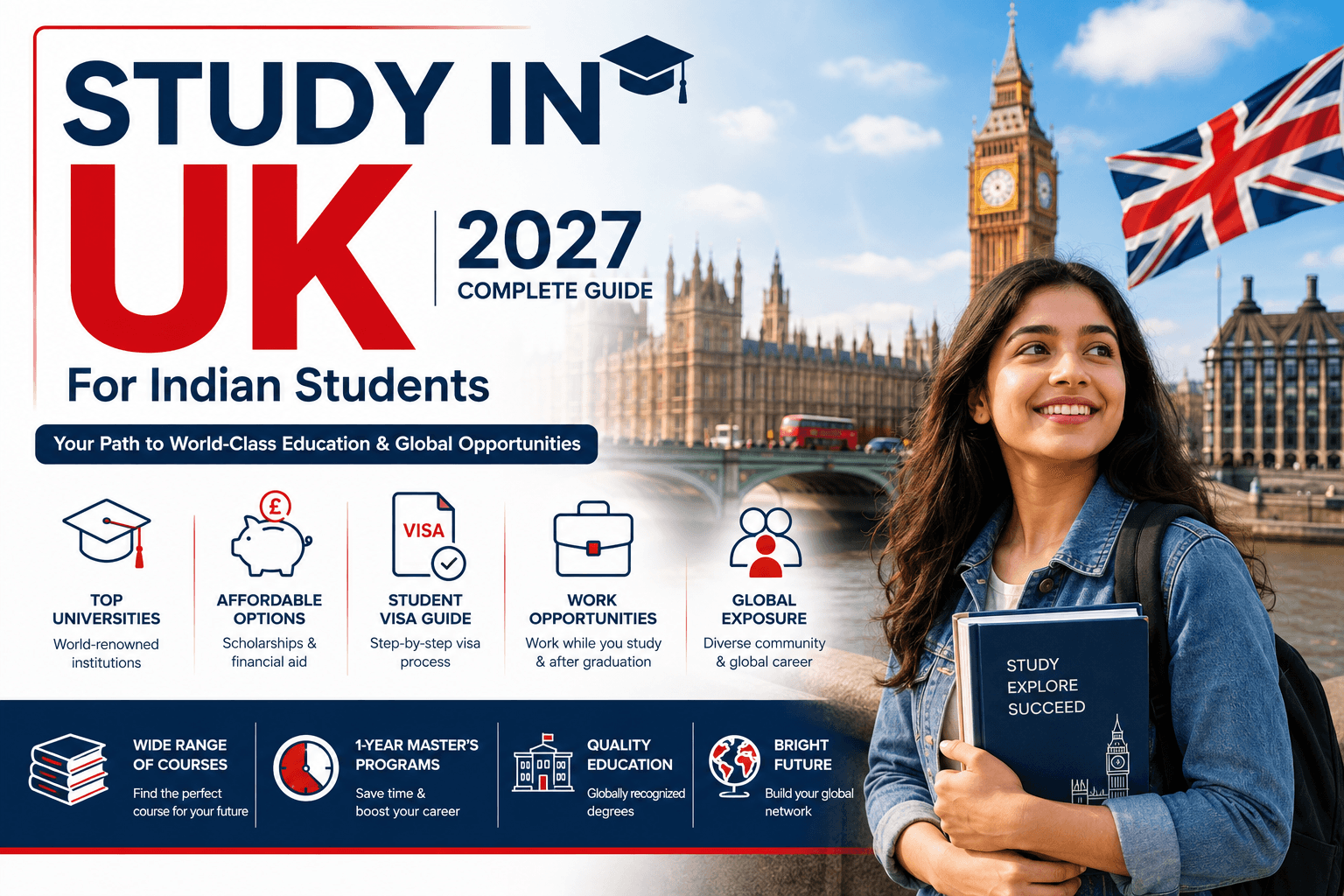
The United Kingdom has been one of the most popular study-abroad destinations for Indian students for decades.
From globally recognised universities and one-year Master's degrees to strong research opportunities and international career exposure, the UK continues to attract students looking for a globally recognised education.
But studying in the UK in 2027 is not simply about getting admission to a university.
Students and parents need to understand the complete journey:
Which university should I choose?
How much does studying in the UK actually cost?
Can I study in the UK without IELTS?
How much money do I need for the UK Student visa?
Can I work while studying?
Can my spouse or children accompany me?
What happens after graduation?
This guide explains the most important things Indian students should know before planning to study in the UK in 2027.
Why Study in the UK in 2027?
The UK remains attractive because its universities offer a combination of academic reputation, international recognition and a wide choice of programmes.
For Indian students, one of the biggest advantages is the availability of one-year Master's programmes.
Instead of spending two years completing a Master's degree in some destinations, many UK universities offer Master's programmes that can be completed in approximately one year.
This can potentially reduce:
Overall living costs
Time spent studying
Opportunity cost
Time before entering the job market
The UK also offers programmes across almost every major academic field.
Popular areas include:
Business
Finance
Computer Science
Data Science
Artificial Intelligence
Engineering
Healthcare
Public Health
Law
International Relations
Marketing
Management
Psychology
Education
Design
Media and Communications
However, the best course is not necessarily the most popular course.
Your choice should be based on your previous education, career plans, budget and future employment opportunities.
Is the UK Good for Indian Students?
Yes, but the answer depends on your individual profile.
The UK can be particularly attractive if you want:
A globally recognised degree
A shorter Master's programme
An English-speaking academic environment
International exposure
Access to global employers
Strong research opportunities
A wide range of specialised courses
The UK is also home to some of the world's most recognised universities.
However, students should not choose a university only because it appears high in a global ranking.
A university that is perfect for one student may not be the right choice for another.
You should consider:
Course content
University reputation in your field
Tuition fees
Location
Accommodation costs
Graduate outcomes
Internship opportunities
Career opportunities
Admission requirements
Best Universities in the UK for Indian Students
The UK has a large number of internationally recognised universities.
Some of the names frequently considered by international students include:
University of Oxford
Oxford is one of the world's best-known universities and offers programmes across numerous disciplines.
Admission is highly competitive, and students need to meet the specific academic and programme requirements.
University of Cambridge
Cambridge is another globally recognised institution with strong programmes across science, technology, humanities, business and other fields.
Imperial College London
Imperial is particularly well known for:
Engineering
Technology
Science
Medicine
Business
University College London
UCL offers a wide range of programmes and has a large international student population.
London School of Economics and Political Science
LSE is particularly recognised for:
Economics
Finance
Politics
International Relations
Social Sciences
Management
University of Edinburgh
The University of Edinburgh offers programmes across areas including:
Computer Science
Engineering
Business
Medicine
Humanities
Social Sciences
University of Manchester
Manchester is a popular choice for international students and offers a broad range of programmes.
University of Birmingham
The university offers programmes across:
Engineering
Business
Computer Science
Social Sciences
Healthcare
Sciences
These universities represent only a small part of the UK's higher-education system.
The right university for you should be selected according to your course, academic profile, budget and career plans.
How Much Does It Cost to Study in the UK?
The cost of studying in the UK depends heavily on the university, course and location.
International students generally need to budget for:
Tuition fees
Accommodation
Food
Transportation
Health-related costs
Visa expenses
Books and study materials
Flights
Personal expenses
Emergency funds
London is generally more expensive than many cities outside London.
This means that two students studying the same subject can have very different total budgets depending on where they live.
For example, choosing a university outside London may significantly reduce accommodation and everyday living expenses.
Tuition Fees in the UK
There is no single tuition fee for international students.
Your tuition depends on:
University
Course
Degree level
Subject
Location
Programme duration
Business, humanities and social-science programmes can have different fees from engineering, laboratory-based or medical programmes.
Before accepting an offer, students should calculate the total tuition for the complete programme, not simply the first instalment.
For a one-year Master's, this is particularly important because the tuition may need to be paid over a relatively short period.
Cost of Living in the UK for Indian Students
Living expenses are another major part of your study-abroad budget.
Your monthly expenses can include:
Rent
Food
Electricity and utilities
Transportation
Mobile phone
Internet
Study materials
Clothing
Personal expenses
Entertainment
Your city can make a significant difference.
London
London offers access to a huge international business and professional environment, but accommodation and everyday expenses can be considerably higher.
Manchester
Manchester has a large student population and can provide a different cost profile from London.
Birmingham
Birmingham is another major student city with universities, businesses and transport connections.
Leeds
Leeds is a major student and business centre and is often considered by international students looking for alternatives to London.
Edinburgh
Edinburgh is an internationally recognised student city, although accommodation costs should be researched carefully before choosing a programme.
The best way to compare universities is therefore to calculate tuition plus realistic living expenses, rather than looking at tuition alone.
How Much Money Do I Need for a UK Student Visa?
This is one of the most important financial questions for Indian students.
For a UK Student visa, you generally need to demonstrate that you can pay your course fees and support yourself financially.
The current UK financial requirement is:
£1,529 per month for students studying in London
and
£1,171 per month for students studying outside London
for up to nine months, based on the current GOV.UK guidance.
This is in addition to the relevant course-fee requirement shown on your Confirmation of Acceptance for Studies.
The exact amount you need to demonstrate can therefore depend on:
Your tuition fee
Amount already paid towards tuition
Where you will study
Your visa circumstances
Whether you qualify for a financial-evidence exemption
Always check the latest GOV.UK requirement before submitting your visa application.
How Long Should the Money Be in the Bank?
UK Student visa financial evidence has specific requirements regarding how long funds must be held.
If you need to provide financial evidence, you should plan your finances well in advance rather than moving money into an account at the last moment.
The UK government specifies rules concerning the required holding period and acceptable financial evidence.
Students should also ensure that their financial documents are genuine, consistent and easy to understand.
UK Student Visa Requirements for Indian Students
To apply for a UK Student visa, you generally need:
A valid passport
An offer from a licensed student sponsor
A Confirmation of Acceptance for Studies, known as a CAS
Evidence of English-language ability where required
Financial evidence where required
Tuberculosis test results where applicable
ATAS certificate where applicable
Additional documents depending on your circumstances
GOV.UK states that students need a CAS from their course provider before applying for the Student visa.
The Student visa application can normally be submitted from outside the UK up to six months before the course start date.
How Much Does a UK Student Visa Cost?
Visa fees can change, so students should always check the current GOV.UK fee before applying.
The current Student visa application fee listed by GOV.UK is £558 for applications made from outside the UK.
Students may also need to pay the Immigration Health Surcharge, depending on the length and circumstances of their visa.
The healthcare surcharge is separate from tuition and living expenses.
Therefore, your UK study budget should include:
Tuition + living expenses + visa fee + healthcare surcharge + travel + other costs.
Can I Study in the UK Without IELTS?
This is one of the most searched questions by Indian students.
The answer is:
Sometimes.
The UK does not have a universal rule that every international student must take IELTS.
Your English-language requirement depends on:
University
Course
Previous education
Nationality
Academic background
Other accepted English-language evidence
Some universities may accept alternatives to IELTS in specific circumstances.
For example, a university may accept another recognised English-language test or alternative evidence depending on its policy.
Therefore, don't search only for:
“UK universities without IELTS.”
Instead, ask:
“Does my chosen university accept my existing English-language qualification or alternative proof?”
That is a much safer way to approach the application.
What Are the Intakes in the UK?
The main UK university intake is generally the September or Autumn intake.
Many universities also offer a January intake.
Some programmes may have other start dates.
However, course availability varies.
A January intake may not offer the same programme selection as September.
If you are targeting 2027, start your research early enough to compare both September and January options.
January vs September Intake in the UK
September Intake
The September intake generally provides the widest choice of:
Universities
Courses
Scholarships
Accommodation
Student societies
Graduate opportunities
January Intake
January can be useful for students who:
Missed the September deadline
Need additional time to prepare
Want to start earlier than the following September
Found a suitable course specifically offered in January
But don't choose January simply because it is available.
Check whether your preferred course actually accepts students in that intake.
Can Indian Students Work While Studying in the UK?
Yes, eligible Student visa holders can work subject to the conditions attached to their visa.
For a full-time degree-level course at a qualifying higher-education provider, students can generally work up to 20 hours per week during term time and full-time during permitted vacation periods.
However, there are restrictions on the type of work students can undertake.
Students should not build their entire financial plan around part-time employment.
Your tuition and essential living costs should already be financially planned.
Part-time employment can provide:
Additional income
Work experience
Exposure to British workplace culture
Opportunities to improve communication skills
But it should not be treated as a guaranteed source of funding.
Can Students Work Full-Time During Holidays?
Students who have permission to work under the relevant Student visa conditions may generally work full-time during permitted vacation periods.
However, your exact work conditions depend on your course and visa conditions.
Always check the conditions attached to your individual visa before starting employment.
Can Indian Students Take Their Spouse to the UK?
This is an area where students need to be particularly careful.
The UK's dependant rules have changed significantly.
For most students starting a postgraduate course on or after 1 January 2024, dependants are generally permitted only where the student is studying a PhD, another doctoral qualification or a research-based higher degree, subject to the relevant rules. Government-sponsored students meeting the applicable criteria can also qualify.
This means a standard taught Master's student should not assume that their spouse can accompany them as a dependant.
This is especially important for students choosing between:
MSc
MA
MRes
MPhil
PhD
Other research-based degrees
The exact classification of the course matters.
If bringing a spouse or children is an important part of your plan, check the current dependant rules before paying a university deposit.
What Is the UK Graduate Visa?
The Graduate visa provides an unsponsored route for eligible international students who successfully complete an eligible UK course.
However, there is an important change for students planning for 2027.
Under the current rules:
Applications made on or before 31 December 2026:
The Graduate visa provides two years.
Applications made on or after 1 January 2027:
The Graduate visa provides 18 months.
PhD and other doctoral graduates can receive three years.
This is a major point for Indian students planning to start a UK degree in 2027.
The Graduate route is also not a settlement route by itself.
Students who want to remain in the UK longer may need to move into another eligible immigration route, depending on their circumstances.
Can You Work After Studying in the UK?
The Graduate visa allows eligible graduates to stay in the UK and work or look for work after successfully completing an eligible course.
It is an unsponsored route, meaning you do not need an employer sponsor to apply for the Graduate visa itself.
However, if your long-term goal is to remain in the UK, you should think about your career strategy before arriving.
Consider:
Which industries are hiring?
What skills are in demand?
Which cities have opportunities?
Does your course lead to relevant jobs?
Will you need professional registration?
Could you eventually qualify for another work route?
A degree is not the end of the journey.
Your career plan should start before you select your university.
Best Courses to Study in the UK
The UK offers thousands of programmes, but some areas are particularly popular among international students.
Business and Management
Popular options include:
International Business
Business Analytics
Management
Marketing
Finance
International Management
Entrepreneurship
Computer Science and Technology
Students can explore:
Computer Science
Artificial Intelligence
Data Science
Cybersecurity
Software Engineering
Machine Learning
Engineering
Popular fields include:
Mechanical Engineering
Civil Engineering
Electrical Engineering
Electronics
Aerospace Engineering
Renewable Energy
Healthcare and Public Health
Options include:
Public Health
Healthcare Management
Health Sciences
Nursing
Biomedical Sciences
Social Sciences
Students may consider:
International Relations
Economics
Psychology
Sociology
Development Studies
Political Science
Scholarships for Indian Students in the UK
Scholarships can help reduce the financial burden of studying abroad.
Students should look at three broad categories.
University Scholarships
Many universities offer scholarships based on:
Academic performance
Nationality
Course
Leadership
Financial circumstances
Some are automatic, while others require separate applications.
Government and External Scholarships
There are also scholarship programmes supported by governments and external organisations.
Eligibility and deadlines vary significantly.
Course-Specific Funding
Some programmes may have specific funding opportunities for students studying particular subjects.
The key is to start scholarship research early.
Do not wait until you receive your admission offer if the scholarship deadline comes earlier.
How to Apply to a UK University
The UK application process depends on whether you are applying for undergraduate or postgraduate study.
For a Master's degree, the process generally involves:
Step 1: Evaluate Your Profile
Look at:
Academic background
Degree
Grades
Work experience
English proficiency
Career goals
Step 2: Select Your Course
Don't choose a course simply because it is popular.
Ask:
Will this course help me reach my career goal?
Step 3: Shortlist Universities
Create a balanced list based on your academic profile and budget.
Step 4: Prepare Documents
Common documents can include:
Passport
Degree certificate
Academic transcripts
CV
Statement of Purpose
Letters of Recommendation
English-language evidence
Work-experience documents where applicable
Step 5: Submit Applications
Follow the university's application process and deadline.
Step 6: Receive Your Offer
Your offer may be conditional or unconditional.
Read the conditions carefully.
Step 7: Meet the Conditions
You may need to submit:
Final academic results
English-language evidence
Additional documents
Deposit payment
Step 8: Receive Your CAS
Once the university has completed the required process, it can issue your Confirmation of Acceptance for Studies.
Step 9: Apply for Your Student Visa
Prepare your visa documentation and financial evidence.
UK Study Visa Timeline for Indian Students
If you are planning for 2027, don't leave everything until the last minute.
12–18 months before your course
Start researching:
Courses
Universities
Tuition fees
Scholarships
Career outcomes
9–12 months before your course
Work on:
University shortlist
SOP
LORs
English test
Academic documents
6–9 months before your course
Start:
University applications
Scholarship applications
Financial planning
Accommodation research
After receiving your offer
Complete:
Conditions
Deposit where required
CAS process
Financial documentation
Visa preparation
Before travelling
Arrange:
Visa
Accommodation
Flights
Insurance where relevant
Original documents
Initial living funds
UK vs Ireland vs Germany for Indian Students
Indian students often compare the UK with Ireland and Germany.
Each destination has different advantages.
UK
The UK can be particularly attractive for:
One-year Master's degrees
Business
Finance
Technology
Research
Healthcare
International exposure
Large university selection
Ireland
Ireland can be attractive for:
Technology
Pharmaceuticals
Business
English-speaking environment
International companies
Germany
Germany can be particularly attractive for:
Engineering
Technology
Manufacturing
Research
Public universities
Technical education
The best destination depends on your course, budget, academic profile and long-term career plans.
Is Studying in the UK Still Worth It in 2027?
This is probably the most important question.
The answer depends on what you expect from your degree.
If your plan is:
Get admission → travel to UK → work part-time → recover all costs → automatically get a job → automatically stay permanently
then you should rethink your strategy.
Studying in the UK requires a much more realistic approach.
A strong plan looks like:
Good university + relevant course + realistic budget + strong skills + internships/work experience + career planning
The UK can still provide significant academic and professional opportunities, but students need to understand that the immigration and employment environment is evolving.
The Graduate visa is already changing from two years to 18 months for applications made from 1 January 2027.
That makes career planning during your degree even more important.
Who Should Consider Studying in the UK?
The UK may be a strong choice if you:
Want an internationally recognised degree
Prefer an English-speaking environment
Want a one-year Master's option
Have a clear career objective
Can manage the total cost
Want international exposure
Are interested in research
Want access to international companies
Are prepared to compete in the graduate job market
Who Should Think Twice Before Choosing the UK?
The UK may not be the right option if:
Your entire plan depends on part-time work
You have not calculated your complete budget
You are choosing a course without researching employment opportunities
You expect your university to guarantee employment
Your main objective is simply to obtain a visa
You are depending on bringing a spouse on a standard taught Master's
You have not researched the latest immigration rules
Choosing a country based on social-media promises can be an expensive mistake.
Common Mistakes Indian Students Make
Choosing a university only because of its ranking
Ranking is important, but it is not everything.
Choosing a course because everyone else is doing it
A popular course does not guarantee a job.
Ignoring total cost
Tuition is only one part of your budget.
Depending on part-time work
Part-time work should supplement your finances, not replace your financial plan.
Ignoring the location
Your living expenses can vary significantly between cities.
Waiting until the last moment for visa documentation
Financial and academic documents should be prepared early.
Assuming all Master's students can bring dependants
Current UK rules significantly restrict student dependants for most taught postgraduate courses.
Believing old information about the Graduate visa
The Graduate visa rules have changed, and students planning for 2027 need to understand the 18-month period currently applicable to applications from 1 January 2027.
Frequently Asked Questions
Is the UK good for Indian students?
Yes. The UK offers internationally recognised universities, a large selection of courses and many one-year Master's programmes. The right choice depends on your academic profile, budget and career plans.
How much does it cost to study in the UK?
The total cost depends on tuition, university, course, city and lifestyle. Students should calculate tuition, accommodation, living expenses, visa costs and travel together.
Can I study in the UK without IELTS?
Some universities may accept alternative English-language evidence depending on the student's circumstances and programme. You should check the specific university's requirements.
How much money do I need for a UK Student visa?
Under the current financial rules, students need to demonstrate course fees plus living-cost funds. The current maintenance requirement is £1,529 per month in London and £1,171 per month outside London, for up to nine months.
Can I work while studying in the UK?
Eligible students on qualifying degree-level courses can generally work up to 20 hours per week during term time, subject to their visa conditions.
Can I bring my spouse to the UK for a Master's?
Most students starting a standard postgraduate taught course cannot bring dependants under the current rules. Exceptions include certain government-sponsored students and eligible students studying qualifying PhD, doctoral or research-based higher degrees.
How long can I stay in the UK after graduation?
For Graduate visa applications made from 1 January 2027, the current period is 18 months for eligible graduates. PhD and other doctoral graduates can receive three years.
Is the Graduate visa a permanent residency route?
No. The Graduate route is an unsponsored temporary route and is not itself a settlement route.
Which is better: UK, Germany or Ireland?
There is no universal answer. The right destination depends on your course, budget, language preferences, university choices and career objectives.
Which UK intake is better: September or January?
September generally offers the widest choice of courses and universities, but January can be a useful alternative where the desired programme is available.
Final Verdict: Should You Study in the UK in 2027?
The UK remains a major study destination for Indian students, but the decision needs to be more strategic than ever.
Don't choose the UK simply because:
“Everyone is going there.”
Choose it because your:
Course + University + Budget + Career + Immigration Plan
make sense together.
The biggest advantage of the UK can be the opportunity to complete a high-quality degree in a relatively short period.
The biggest challenge can be managing the cost and planning your career in an increasingly competitive environment.
If you are considering the UK for 2027, start planning early.
Planning to Study in the UK in 2027?
Not sure which university, course or intake is right for you?
Niyasa Global can help you evaluate your:
Academic profile
Course options
University choices
Budget
Scholarship opportunities
Admission requirements
Student visa preparation
Long-term study and career plan
Get Your UK Profile Evaluated
Instead of applying randomly to universities, build a study-abroad plan around your actual profile.
Speak with Niyasa Global and start planning your UK study journey for 2027.
Important Note
UK university admission requirements, tuition fees, scholarship availability, visa fees, financial requirements and immigration rules can change.
The immigration information in this article reflects the current UK government guidance available at the time of publication. Students should verify the latest requirements on GOV.UK and with their chosen university before applying.
Niyasa Global does not guarantee admission, visa approval, employment, Graduate visa approval or a particular career outcome.